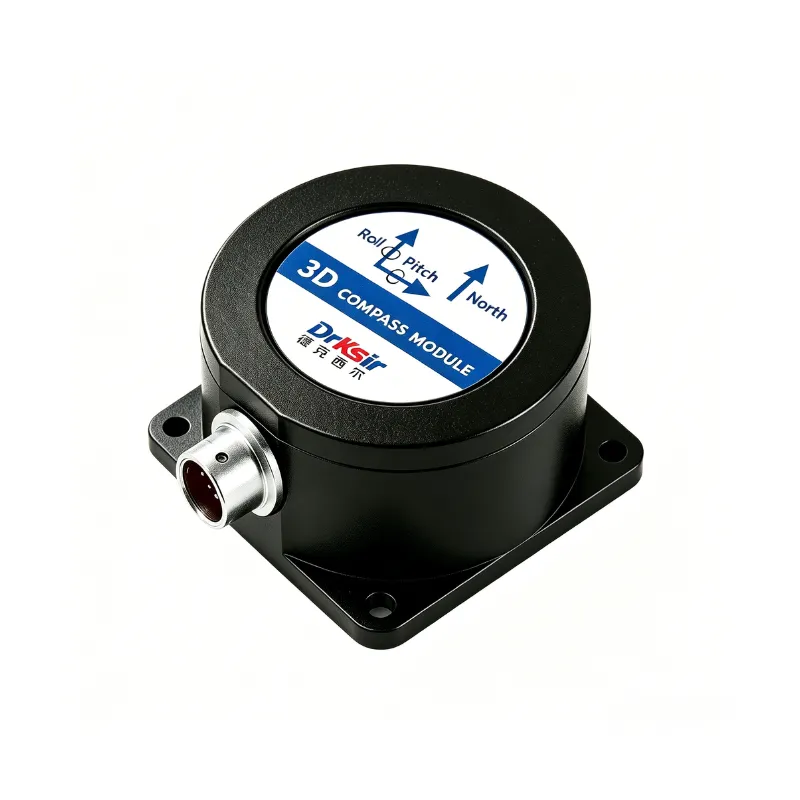
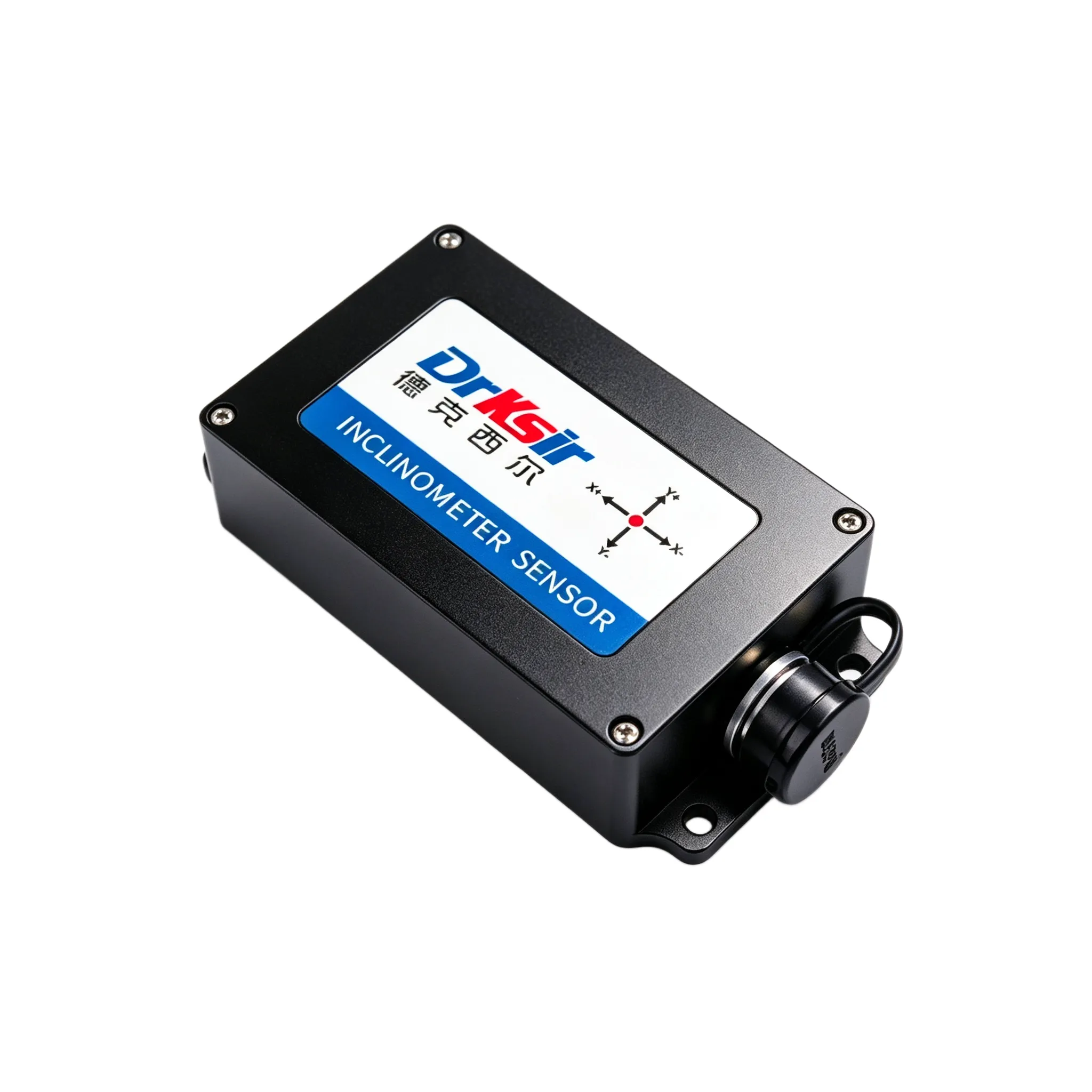
When a procurement officer emails me asking for “the most accurate tilt sensor Drksir makes,” I almost always answer with a question first: “How big is the real movement you need to capture?”
It turns out that about 80% of the time, the 0.001° flagship is overkill for the job. And the other 20% of the time, the budget-friendly 0.1° sensor would have missed a critical defect.
The four accuracy tiers we ship — 0.1°, 0.01°, 0.005°, and 0.001° — exist because each one fits a different kind of job. Picking the right tier saves you money without losing data quality. Picking the wrong tier either wastes budget or, worse, fails your acceptance test.
This guide walks through what each tier actually delivers on the datasheet, where it performs best, and where it falls short.
The Four Accuracy Tiers at a Glance
| Accuracy | Typical Range | Drksir Family | What It Means |
| 0.1° | ±90° | DR-INC-100 series | General purpose, low cost |
| 0.01° | ±60° | DR-INC-200 series | Industrial workhorse |
| 0.005° | ±30° | DR-INC-300 series | High precision |
| 0.001° | ±10° | DR-INC-500 series | Ultra-high accuracy |
Now let me walk through each tier in detail.
Tier 1 — 0.1° General-Purpose Inclinometers
The 0.1° sensor is the cheapest and the most forgiving on cable length and power quality. It is built for applications where you don’t need precision — you need a go/no-go signal or coarse leveling feedback.
Specs at a glance:
- Resolution: 0.05° or better
- Long-term stability: ±0.5° typical
- Operating temperature: -40°C to +85°C
- Common outputs: 4-20mA, RS485
- Cable runs: up to 1,200 m on RS485
Where we see 0.1° sensors deployed:
- Solar tracker positioning — within ±0.5° of the sun is fine, so 0.1° is plenty
- Vehicle leveling on trucks, RVs, mobile platforms
- Basic platform leveling in warehousing and packaging lines
- Alarm triggers on tower cranes (the question is just “is it leaning past the safe angle?”)
If you are essentially replacing a tilt switch with a continuous-reading sensor, the 0.1° tier is your pick.
Tier 2 — 0.01° Industrial-Grade Inclinometers
The 0.01° tier is the workhorse. About 60% of the tilt sensors we ship each year land in this band. It offers enough precision for most industrial machinery while still tolerating shock, vibration, and temperature swings.
Specs at a glance:
- Resolution: 0.005°
- Long-term stability: ±0.05° typical
- Operating temperature: -40°C to +85°C
- Common outputs: 4-20mA, RS485, CAN
- IP67/IP68 housing options
Where 0.01° becomes essential:
- Excavator pitch and roll monitoring — even a 0.5° tilt on a 4-meter boom puts the bucket 35 mm off target, so 0.01° gives you margin to spare
- Crane safety systems, where regulations typically require tilt detection to 0.1° resolution
- Foundation leveling on industrial presses, where 0.01° translates to roughly 0.2 mm per meter of surface error
- Mobile equipment attitude monitoring on mining and forestry machinery
If the OEM you are supplying asks for a tilt sensor with “industrial-grade accuracy,” they usually mean this band.
Tier 3 — 0.005° High-Precision Inclinometers
The 0.005° tier sits between general industrial use and laboratory-grade precision. Most precision-machinery builders settle here when 0.01° isn’t quite enough but 0.001° would change the project budget.
Specs at a glance:
- Resolution: 0.001°
- Long-term stability: ±0.01° typical
- Operating temperature: -40°C to +85°C
- Common outputs: RS485 (Modbus RTU), 4-20mA
- IP67/IP68 available
Classic 0.005° use cases:
- Wind turbine tower tilt monitoring during startup, shutdown, and gust events
- High-precision stage and lift positioning, where sub-100-micron alignment matters
- Semiconductor and photovoltaic manufacturing equipment
- Foundation settling on large rotating machinery (turbines, generators)
Tier 4 — 0.001° Ultra-High Accuracy Inclinometers
The 0.001° tier is the flagship. Only a small fraction of projects genuinely need this level of resolution, but the ones that do cannot be done with anything else.
Specs at a glance:
- Resolution: 0.0005°
- Long-term stability: <0.001° across -40°C to +85°C
- Measuring range: ±5° to ±30° selectable (with accuracy scaling by range)
- Common outputs: RS485 (Modbus RTU), 4-20mA
- IP67/IP68 housing
Where 0.001° is a hard requirement:
- Bridge pier deflection monitoring — bridge decks can flex 5-15 mm under traffic load, which translates to a tilt well under 0.01° at the pier cap
- Dam tilt monitoring on concrete gravity dams, where thermal expansion produces daily cycles in the 0.005° range and you must see the underlying structural trend
- High-speed rail pier monitoring, where a settlement signal of 1 mm over 50 years still matters
- Long-term building settlement on high-rise structures during the first 2-3 years after completion
- Tunnel convergence in soft-ground metro lines
If your monitoring target moves under 0.005° under normal conditions, you need the 500-tier sensor.
Four Questions to Ask Before You Pick a Tier
Before you commit, run through these:
1. What real-world movement do you need to capture? A useful rule of thumb: choose a tier whose accuracy is at least 5-10× better than your smallest meaningful deflection. If your target moves 0.05° during operation, a 0.01° sensor captures it cleanly; a 0.1° sensor will miss most of it.
2. How long is your cable run, and what interface do you have? Cable runs over 500 m favor 4-20mA or RS485. PLC analog inputs favor 4-20mA. SCADA and data acquisition systems favor RS485 with Modbus RTU.
3. What is the temperature swing on site? Industrial sites can hit -30°C in winter and +70°C inside enclosures in summer. The lower accuracy tiers tolerate this easily; the 0.001° tier needs to be specified correctly for the operating range.
4. What is the budget per sensor? 0.1° sensors start in the tens of dollars. 0.001° sensors typically land in the high hundreds to low thousands. Picking the right tier on the first attempt saves a re-design.
How Sensor Pricing Changes With Accuracy
You can roughly expect a 3-5× price jump from 0.1° to 0.01°, and another 3-5× jump from 0.01° to 0.001°. The reason is mostly mechanical: higher accuracy requires tighter MEMS alignment, lower-noise signal conditioning, better temperature compensation, and individual factory calibration.
That said — a 0.001° sensor is not “5× better” than a 0.1° sensor. It is “more expensive to make, and only worth it if you actually need the resolution.”
Common Mistakes When Picking an Accuracy Tier
I see the same three mistakes repeatedly:
Going too high “to be safe.” A 0.001° sensor on a vibrating machine platform will show you noise, not signal. The vibration signal at 0.05° swamped the 0.001° reading, and the operator concluded “the sensor is unstable.”
Going too low to save budget. A 0.1° sensor on a bridge pier will return a steady “no movement” reading because the actual deflection is below the resolution. The monitoring system looks fine on paper — until something shifts.
Forgetting temperature drift. A 0.001° spec at room temperature is meaningless unless the sensor holds that spec across the operating temperature range. Always check the datasheet for the full-temperature accuracy.
Wrapping Up
The right accuracy tier is whichever one captures your smallest meaningful deflection without flooding you with noise. Run through the four questions above, pick the lowest-cost tier that meets your acceptance criteria, and you will usually land on the 0.01° or 0.005° band for machinery work — and the 0.001° band only for structural health monitoring.
Need help sizing a tilt sensor for your specific job? Send us your deflection budget, cable run length, and target interface — we will reply with a spec recommendation within one business day.
📧 Email: sales@drksirsensor.com | 💬 WhatsApp: +86-135-1581-0281