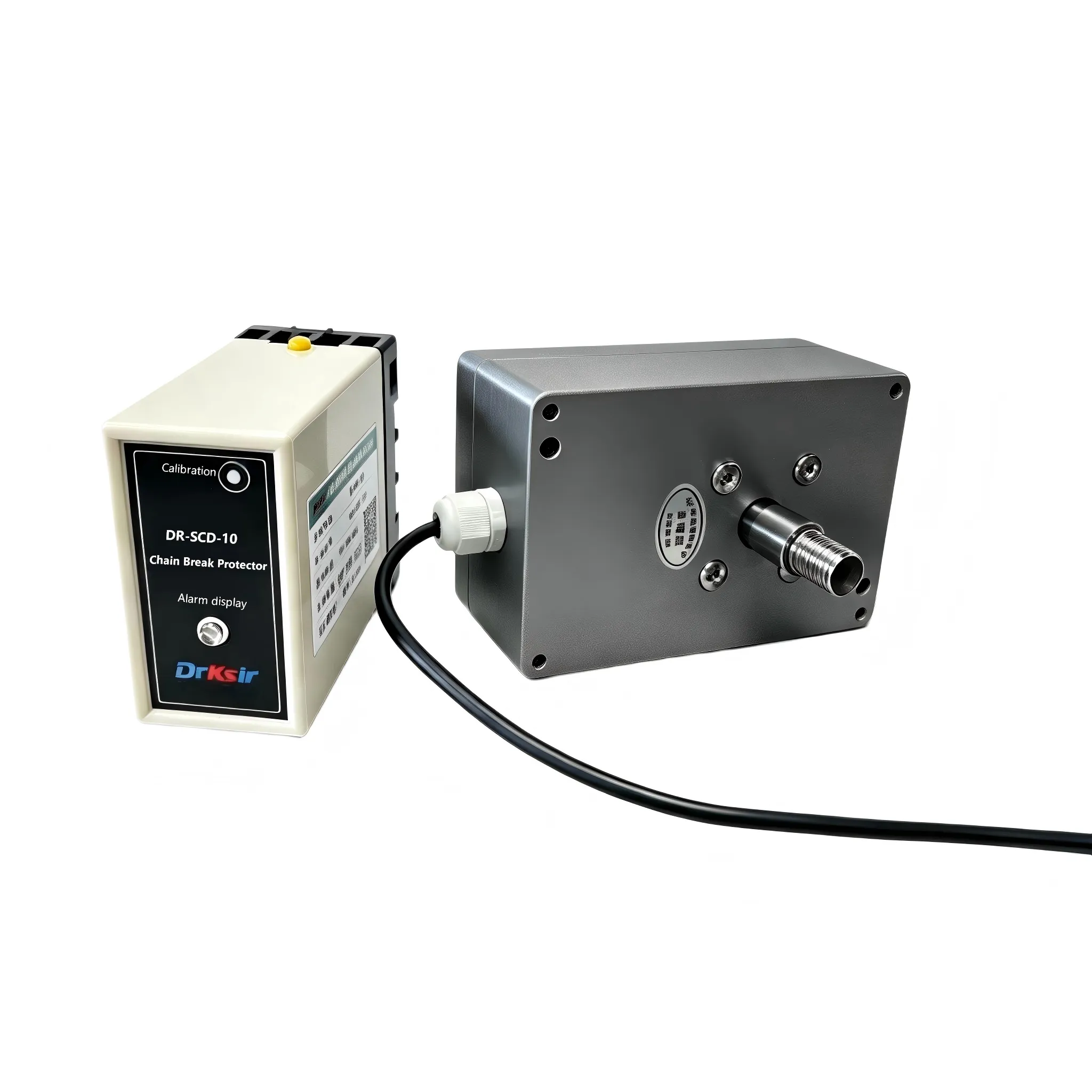
Every few weeks a plant engineer tells me the same story: a chain broke on their scraper conveyor, the line kept running for a few seconds, and by the time someone hit the stop button three meters of flight pan were wrecked. “How would a zero speed switch have prevented that?” they ask. The answer is simpler than most people expect. A zero speed switch never watches the chain itself — it watches the shaft that drives the chain, and it cuts the motor the instant that shaft slows or stops. In this guide I’ll walk through the whole chain of events, part by part, using the drksir SCD-10 family as the concrete example, so you can judge whether one belongs on your line.
What a Zero Speed Switch Actually Protects Against
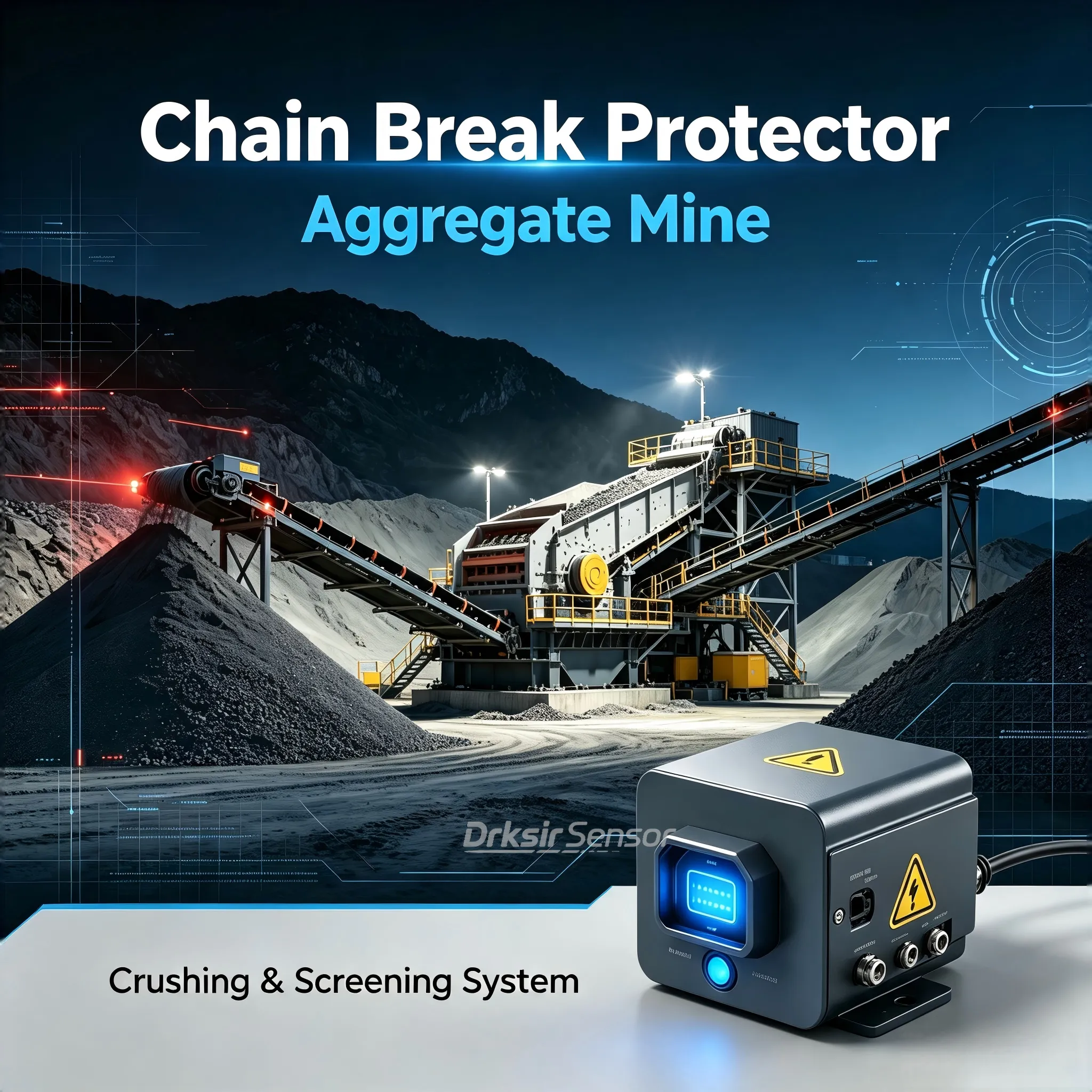
A zero speed switch is an under-speed protection device. Its job is to detect when a driven machine has slowed below a safe rate or stopped entirely — usually because the chain broke, slipped, or jammed. On a conveyor, a broken chain that keeps getting dragged by the drive sprocket does not just stop the line; it chews through pan sections, bends flights, and can pull the whole loop off its track. The faster you stop the drive after the failure starts, the less secondary damage spreads. That is the whole point: turn a cascade failure into a clean, early stop.
The Core Idea: Watch the Shaft, Not the Chain
Here is the part that surprises people. The sensor does not touch the chain. It couples to the driven shaft — the rotating shaft that the chain is supposed to turn. As long as the chain is intact and loaded, that shaft turns at a predictable speed. The moment the chain breaks or slips, the shaft loses its load (or stalls against a jam), and its speed drops. By watching the shaft, the switch sees the failure within a fraction of a revolution — long before a human at the control panel would notice. This is why a properly fitted zero speed switch catches a broken chain even when the broken link is nowhere near the sensor.
Mechanical Coupling: How the Sensor Reads Speed
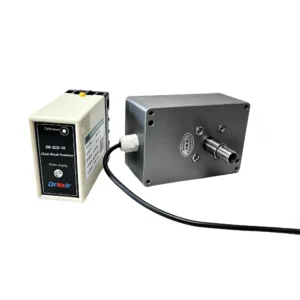
On the drksir SCD-10 family the speed sensor connects to the driven shaft through a threaded screw at the shaft end. The driven shaft turns the sensor screw directly, so the sensor’s reading tracks true shaft RPM with no slip and no drift — even at zero speed, where an optical or proximity method can lose its reference. Mounting takes a few minutes at the shaft end or bearing-housing face. This contact method is deliberately different from a chain-skew protector: a chain skew switch such as the DR-ICD-20 watches the chain itself with a non-contact sensor, because its failure mode is the chain drifting or climbing toward derailment rather than the shaft stopping. Two different failure modes, two different things to watch.
From Pulse to Trip: How It Decides to Stop
Inside the controller, the sensor’s pulse is compared against a threshold you set as a percentage of normal running speed — 40 %, 50 %, 60 % or 70 %, selected by a switch. On startup, once the enable terminal sees a run signal, the unit captures the live shaft speed and stores it as the baseline “normal” speed (that is what the one-button auto-calibration does: hold the Set/Reset button 3 seconds and it learns the running speed in 2–300 seconds, no laptop needed). During operation it keeps comparing real-time speed to that baseline. When the chain breaks and the shaft drops below the set fault value, the potential-free relay switches and cuts the driving motor. A 20-second start-up delay holds the output until the line reaches steady speed, and wiring the enable terminal to the contactor’s auxiliary contact means the protector only arms once the drive is actually running — so you don’t get false trips during acceleration.
The Electrical Side in Plain Terms
The controller runs on AC 220 V, 50 Hz (under 3 W) and supplies 12 V to the speed sensor, which operates on DC 10–30 V. The output is a potential-free relay contact rated AC 220 V / 5 A (also DC 24 V / 5 A) with both NO and NC available — so it drops straight into a motor contactor coil, a PLC input, or an alarm circuit. The sensor itself is IP65 and rated −20 ℃ to 65 ℃ at up to 95 % relative humidity, built for the dust, splash and heat of power, cement, grain and wastewater plants.
Where Zero Speed Switches Get Installed
Because the principle is “watch any driven shaft,” the same device fits a wide range of machines. A scraper conveyor uses the DR-SCD-10-G to catch a snapped or slipped chain before it wrecks the pan. A bucket elevator uses the DR-SCD-10-T on its head or foot shaft, so a broken or slipped belt halts the elevator before the loaded buckets free-fall and rollback. A slag conveyor — wet, hot, abrasive — uses the DR-SCD-10-L, because a stalled chain there seizes pumps and reducers fast. Mixers and agitators use the DR-SCD-10-J to cut power the moment the shaft stalls, protecting the gearbox from burnout. In short: any shaft-driven machine where a slowdown must stop the drive before secondary damage spreads.
Common Misunderstandings
Three things I have to correct constantly. First, “it measures the chain” — no, it measures the shaft; that is what makes it fast and reliable. Second, “it needs a laptop to set up” — no, one-button auto-calibration learns the speed for you. Third, “it will false-trip every time the conveyor starts” — no, the 20-second start-up delay and the enable-terminal wiring handle that. Get those three right and a zero speed switch is one of the lowest-maintenance safety devices on the line.
Wrapping Up
A zero speed switch is a shaft-watcher: contact-coupled to the driven shaft, baseline-learned on startup, threshold-tripped on slowdown, relay-cut on failure. If your conveyor, elevator or mixer can suffer a broken chain, slipped belt or stalled shaft, it belongs on the drive. All of our conveyor safety switches share this principle, and we will help you pick the right variant for your machine.
Need help sizing a zero speed switch for your equipment? Send us the machine type, shaft speed and what you need to catch — we reply with a recommendation within one business day.
📧 Email: sales@drksirsensor.com | 💬 WhatsApp: +86-135-1581-0281