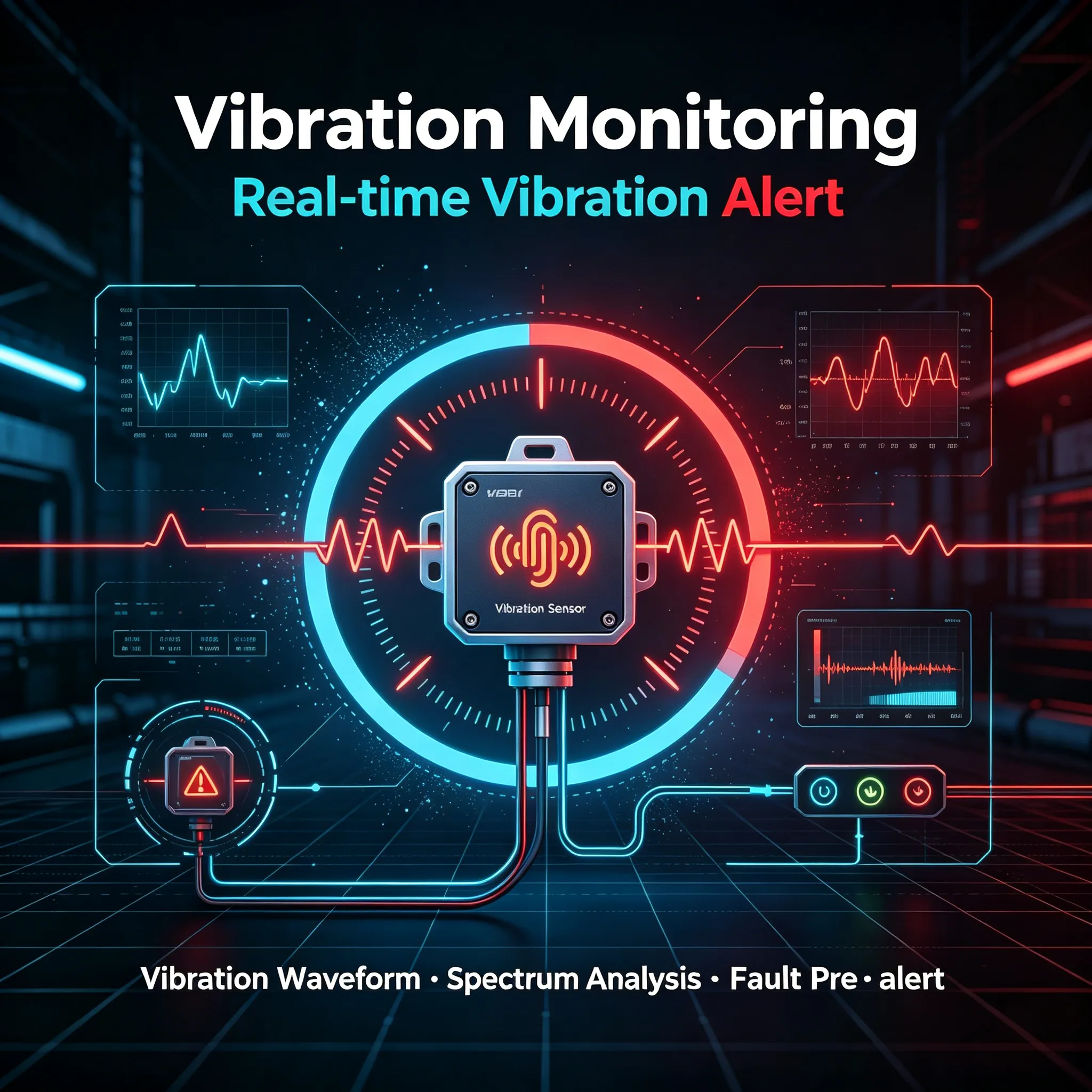
Vibration monitoring with accelerometers is the quiet workhorse behind most predictive maintenance programs, and it is also the easiest one to start small. A healthy rotating machine has a repeatable vibration signature; as bearings wear, couplings misalign or impellers go out of balance, that signature shifts weeks or months before anything actually breaks. Catch the shift early and you schedule the repair on your calendar instead of the machine’s.
Why an accelerometer and not something else
For rotating equipment the interesting faults live at higher frequencies and higher acceleration than a human hand or a simple velocity pickup can see. An accelerometer rides the surface of the machine and reports acceleration directly, which is exactly what bearing defects and gear-mesh problems throw off. On our triaxial units you get X, Y and Z from a single mounting point, so one sensor captures the whole motion vector instead of forcing you to guess which axis holds the fault.
The measurement chain that actually matters
The sensor is only the first link. What decides whether your program works is the chain after it:
- Mounting — stud-mounted as close to the bearing as you can get, on a clean flat face. A loose or magnetic mount rolls off the high frequencies where early bearing faults show up.
- Sampling — our CAN-version accelerometers sample at 100 Hz, which covers the rotation and fault frequencies of most plant machinery. (The CAN variant is in stock now; 4-20mA, RS485 and 0-10V are available on request.)
- Conversion — the raw acceleration trace is turned into a spectrum (FFT) so a fault at, say, the ball-pass frequency of an outer race stands out from the noise.
- Cabling — shielded cable, shield grounded at the controller end only, keeps the plant floor from drowning your signal.
What you are really listening for
Most programs watch three families of fault:
- Bearing defects — inner-race, outer-race and ball-spin frequencies that appear as new peaks in the spectrum.
- Imbalance — a clean 1× rotational-frequency tone that grows as the rotor loads up.
- Misalignment — energy at 2× and 3×, often with an axial component.
Severity is judged against a reference such as ISO 10816 / ISO 20816 vibration zones — zone A is good, zone D means stop and fix. The point is not to become a vibration analyst overnight; it is to notice when “this machine” drifts out of its own baseline.
Mounting pitfalls that ruin the data
Most “sensor problems” we get called about are really mounting problems. A magnetic base stuck on a painted or dirty surface detunes above a few hundred Hz — exactly where early bearing faults live — so you believe the machine is healthy when it is not. Stud-mounting on a clean, flat, bare-metal face is the only way to trust high-frequency data. Keep the cable clear of moving parts and strain-relieved, and ground the shield at the controller end only. Get the mount right and the rest of the program is straightforward.
Where plants usually start
The cheapest wins are the assets that run continuously and fail expensively: motors, pumps, fans, compressors and gearboxes. These sit squarely in the low single digits of g during normal operation, which is why our ±8g accelerometer is the default starting point for a predictive maintenance build — enough range for start-up surges, enough resolution to see wear creep in.
Choosing the sensor for the job
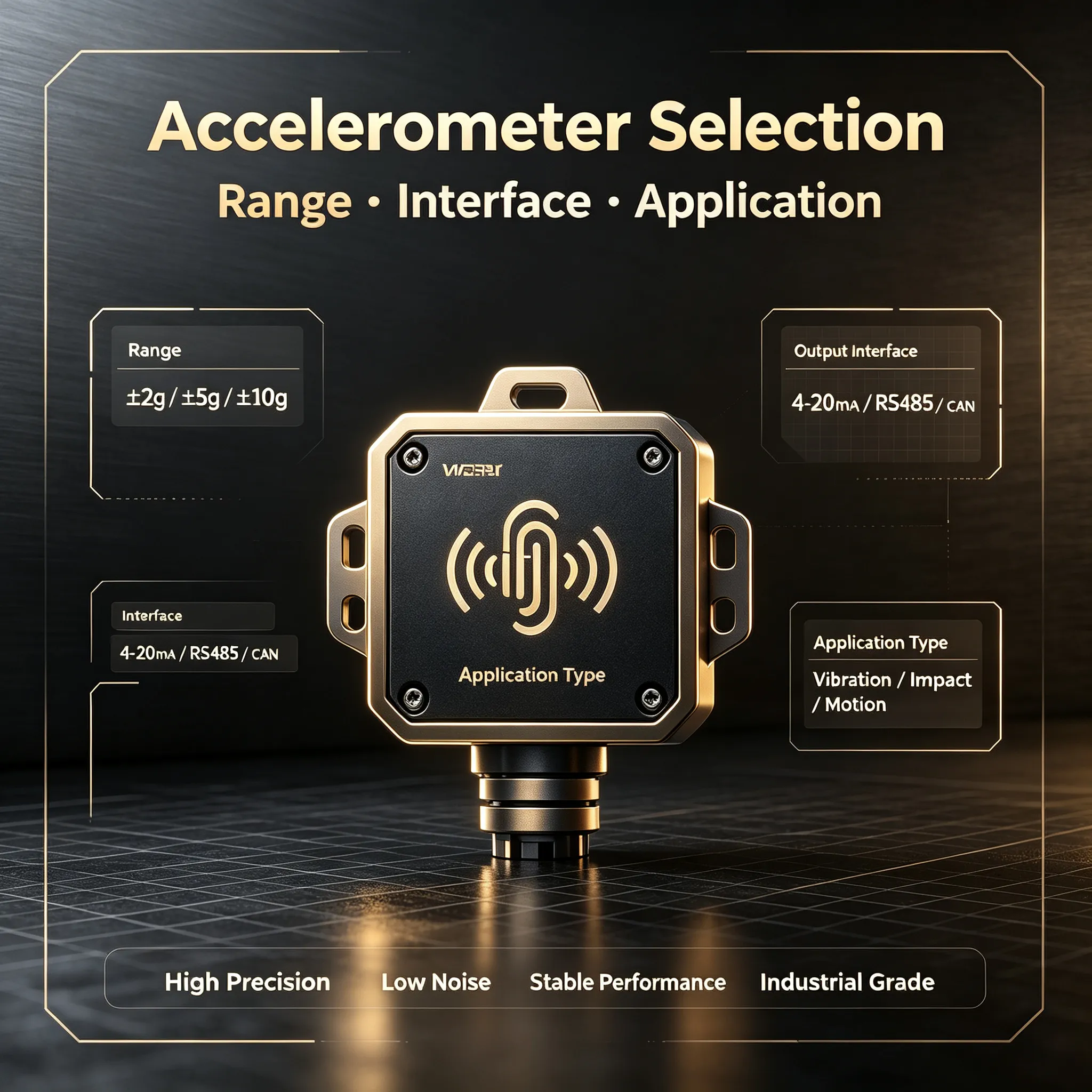
Range is the first decision, and it follows the machine, not the catalog:
| Machine behavior | Range to spec | Notes |
| Tilt, slow structural sway, wind-tower movement | ±2g accelerometer | low-frequency, small-amplitude |
| Motors, pumps, fans, gearboxes | ±8g accelerometer | the predictive-maintenance workhorse |
| Excavators, AGVs, stamping presses | ±16g accelerometer | regular shock and impacts |
| Drop, crash and forging tests | ±32g accelerometer | high-g, millisecond events |
All four share one platform — 0.01g accuracy, 0.001g resolution, 3-axis, IP67/IP68, −40 to +85 °C — and live in our industrial accelerometers range. If the question is slow tilt rather than running vibration, our inclinometers are the more accurate instrument for that job. For the full selection logic, see our guide on how to choose an industrial accelerometer.
From raw waveform to an action
A sensor that just records is a data sink, not a maintenance program. The loop that pays back is: baseline a healthy machine, trend the same measurement weekly, and act when a fault frequency rises above its zone limit. Start with five or six critical assets, prove the warnings are real, then widen the net. Most teams find that catching one failed bearing before it takes out a gearbox covers the whole sensor budget.
Frequently asked questions
How many sensors do I need to start? Five to ten on your most critical rotating assets is enough to prove the value. You do not need plant-wide coverage on day one.
Is 100 Hz sampling enough? For the vast majority of motors, pumps and fans up to a few thousand rpm, yes — 100 Hz captures the rotation and fault frequencies with margin. Very high-speed spindles are a different conversation; tell us the speed and we will advise.
Do I need a vibration analyst on staff? No. Trending against a machine’s own baseline surfaces the obvious faults; you call in analysis only for the ambiguous ones.
Get a quote
Vibration monitoring with accelerometers pays for itself the first time it catches a bearing before it fails. Contact our engineers with your machine types, speeds and mounting positions and we will recommend a range and an output, then quote it. 📧 sales@drksirsensor.com 💬 WhatsApp: +86-135-1581-0281