Project Background
High-speed rail is unforgiving to geometry. Track alignment tolerances on a high-speed line are a fraction of those on conventional rail, and a pier or viaduct section that settles or rotates even slightly can change the ride quality and, in the extreme, the safe operating envelope. Because trains pass at short intervals, the monitoring system has to do two things at once: track slow settlement over months, and capture the short transient tilt that occurs while a train is actually on the span.
The Challenge
- Transient events matter — the tilt signature during train passage lasts seconds; sensors that sample slowly or average heavily will miss it.
- Settlement is slow and small — the long-term movement being tracked is in the millidegree range and would be invisible to standard industrial tilt sensors.
- Pier-top installation — sensors sit outdoors at pier caps and on viaduct soffits with no shelter, exposed to vibration, weather and temperature cycling.
- Distributed monitoring — a single project may instrument dozens of piers along a section, all feeding one data acquisition system.
- No false alarms — the system must not flag normal thermal and load response as a settlement event.
The Solution
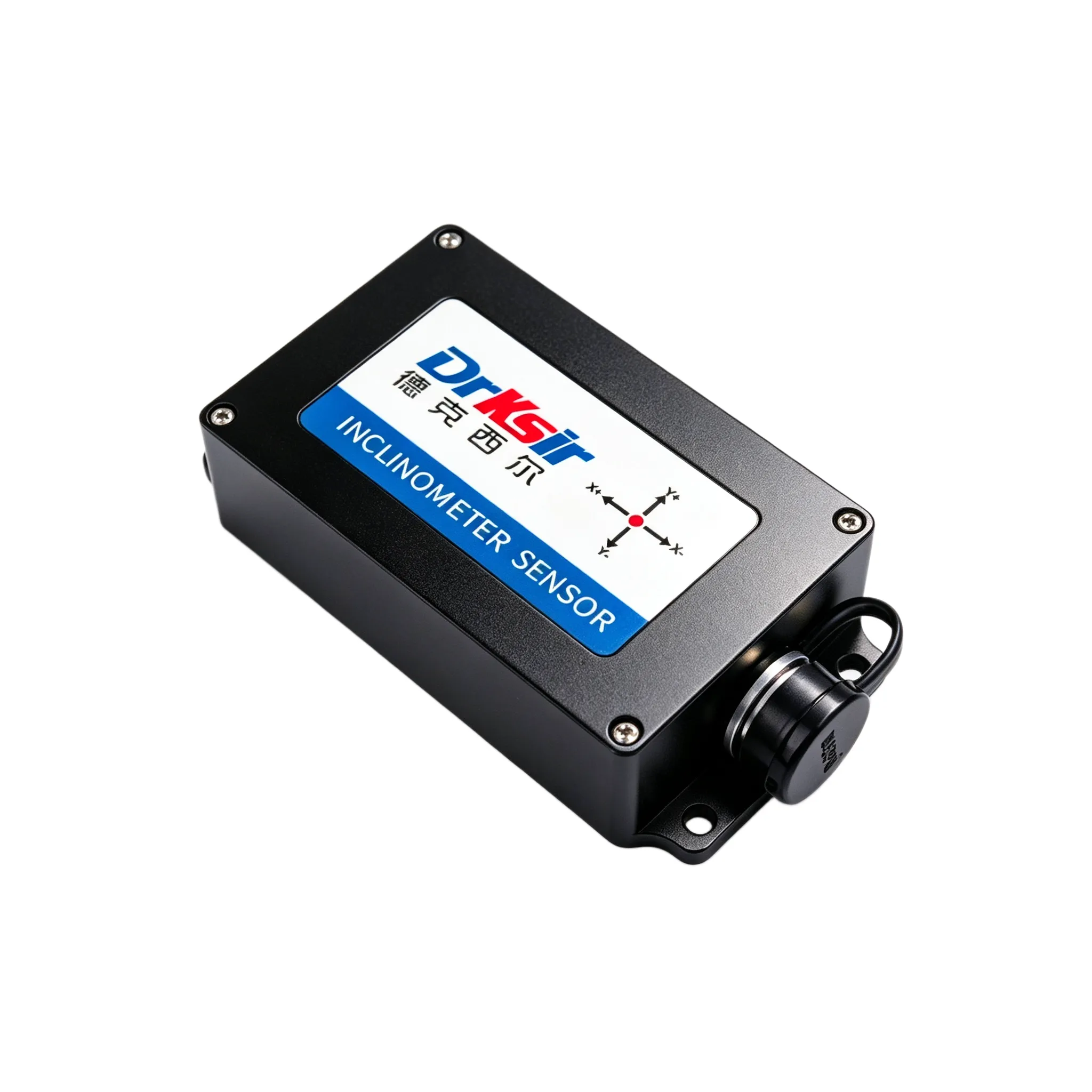
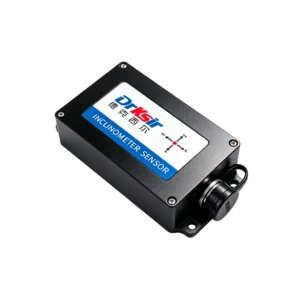
Piers are instrumented with the DR-INC-500-R-D-10 dual-axis inclinometer, factory-set to the ±10° range (with ±5° / ±20° / ±30° available). Its 100 Hz sampling frequency means a train passing over the span produces a dense tilt trace rather than a single averaged number — the transient response can be inspected directly instead of inferred.
All pier nodes are addressed on a shared RS485 bus and read over Modbus RTU (9600 baud, 8N1), so a long section of piers is polled through one trunk line rather than one analog channel per sensor. X-axis and Y-axis tilt are returned as register values through standard Modbus function codes, and the register map plus sample code are available for the owner’s SCADA integrator.
The 0.001° absolute accuracy at ±5°/±10° and 0.0005° resolution allow the slow settlement trend to be separated from the repeating load response of each train pass — the two signals differ by orders of magnitude in timescale, and both need to be visible simultaneously. Housings are IP67 / IP68 (customizable) for exposed pier-top mounting, rated −40 ℃ ~ +85 ℃, and the 4-core shielded cable carries power and data over the run back to the local cabinet.
Where the section’s data system uses analog inputs rather than a digital bus, the identical DR-INC-500-A-D-10 4-20mA version can be substituted without changing the mounting.
Why This Model
- 100 Hz sampling captures the transient tilt during train passage, not just the steady-state value.
- 0.001° class accuracy is required to see millidegree settlement at all.
- RS485 / Modbus RTU lets dozens of pier nodes share one trunk and one data acquisition channel.
- IP67 / IP68 and −40 ℃ ~ +85 ℃ suit unsheltered pier-top installation.
- ≥55,000 hours service life and 24-month warranty match the multi-year monitoring horizon of a rail infrastructure project.
Results / Outcome
- Settlement trends across the instrumented piers are tracked continuously instead of through periodic manual survey.
- The 100 Hz trace makes the train-passage response visible, so the system can distinguish repeatable load response from genuine drift.
- One RS485 trunk serves the whole pier array, simplifying cable routing and data acquisition.
- The resulting dataset supports comparison of measured behaviour against the design model over time.
Related Products
- DR-INC-500-R-D-10 — 0.001° Ultra-High Accuracy RS485 Inclinometer
- DR-INC-500-A-D-10 — 0.001° Ultra-High Accuracy 4-20mA Inclinometer
- Browse all industrial inclinometers
- Send us your pier count, span and expected settlement and we will advise on node layout. Request a quote.
Get a Quote
Send us your pier count, span and expected settlement and we will advise on node layout, sampling rate and bus arrangement.
📧 Email: sales@drksirsensor.com | 💬 WhatsApp: +86-135-1581-0281