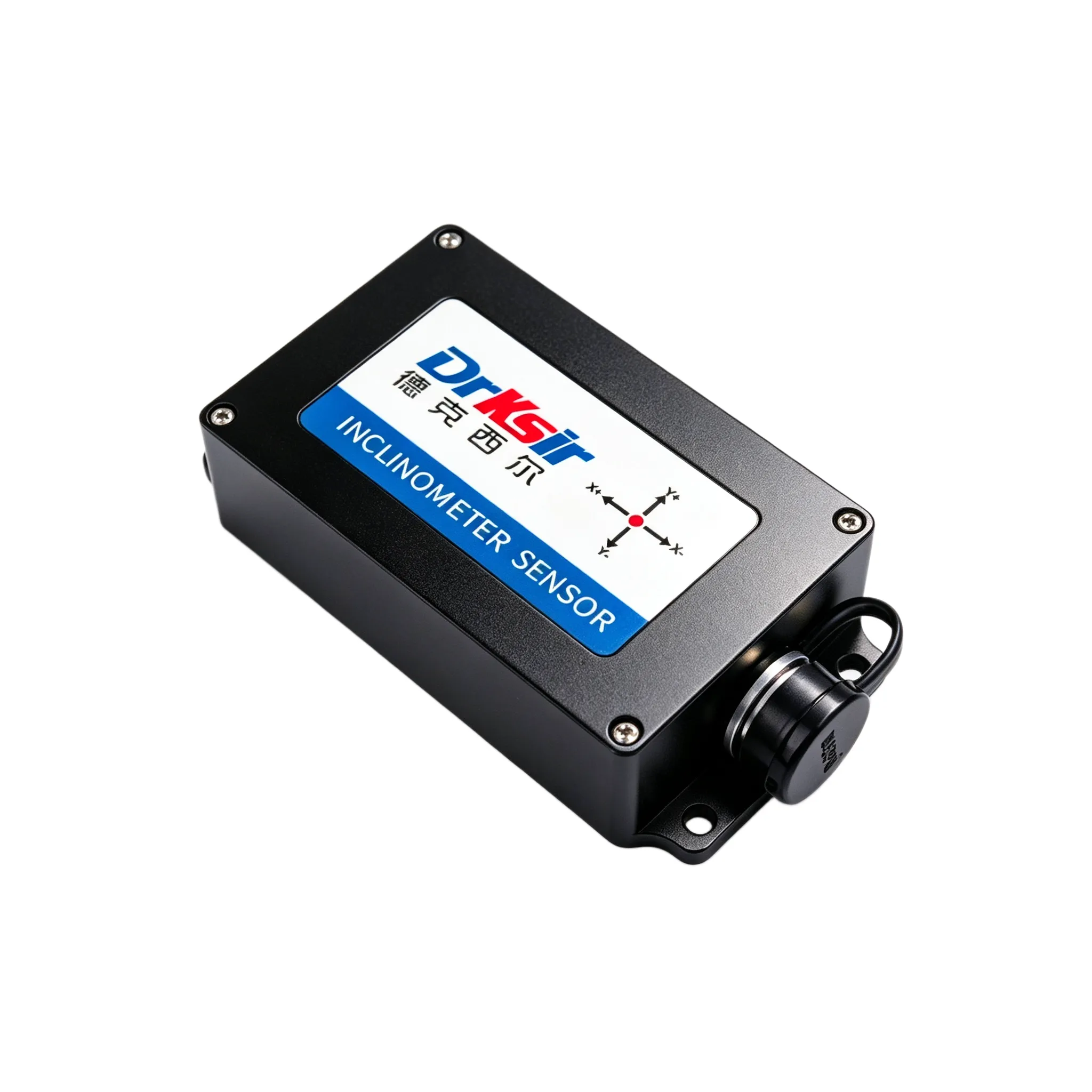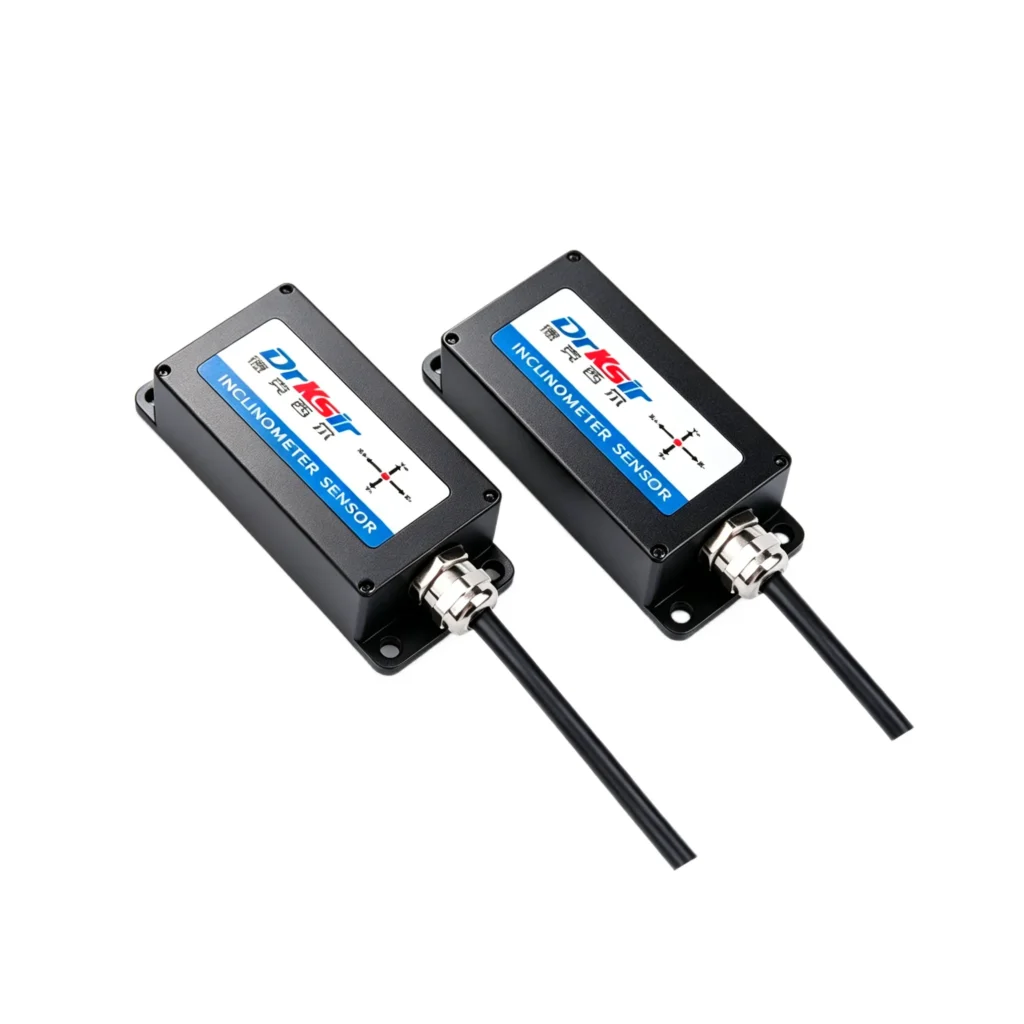
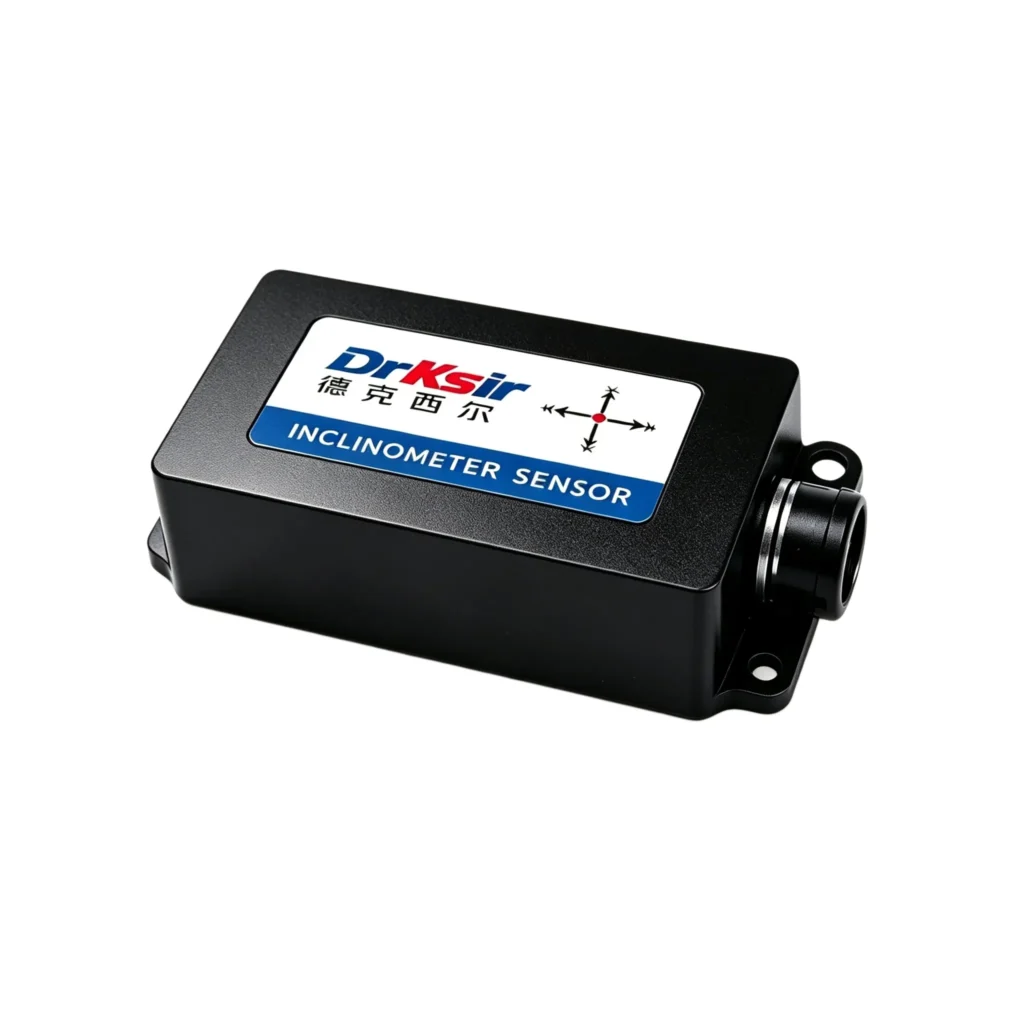
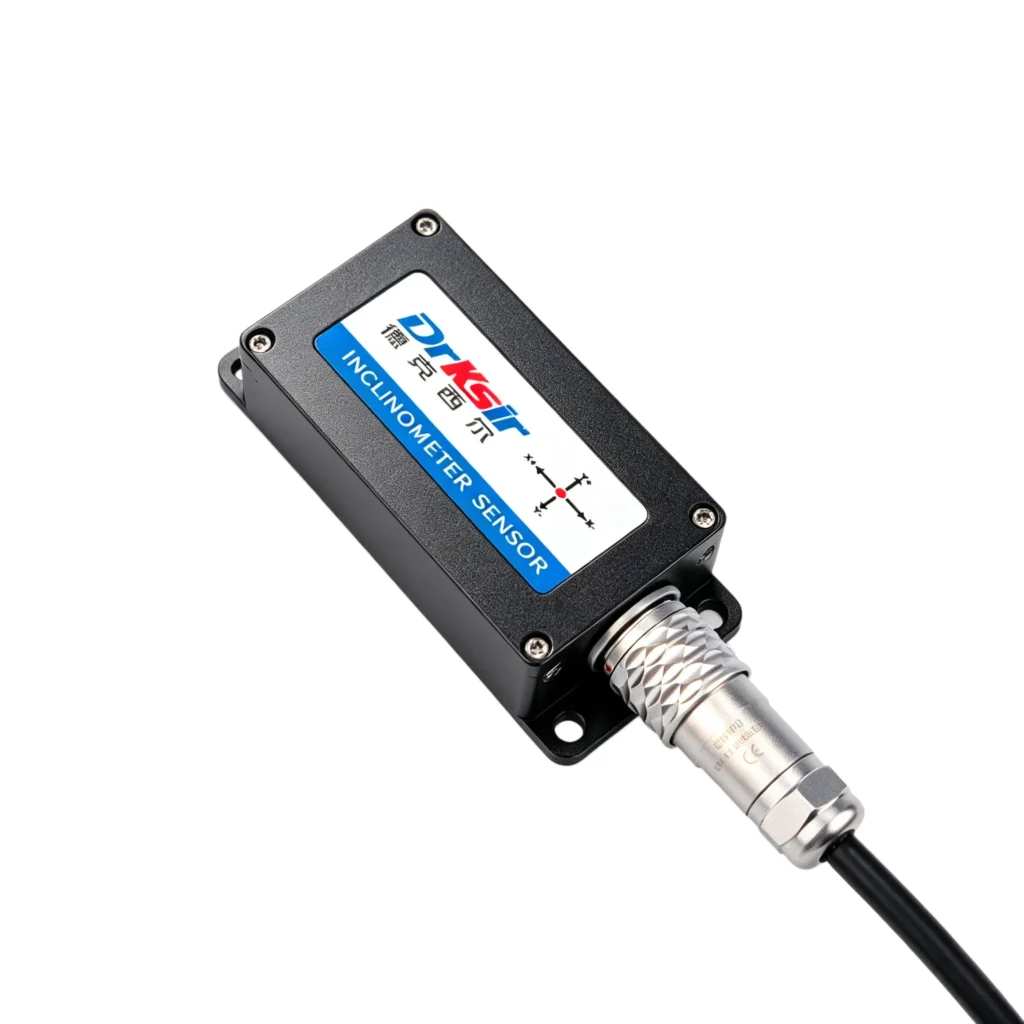
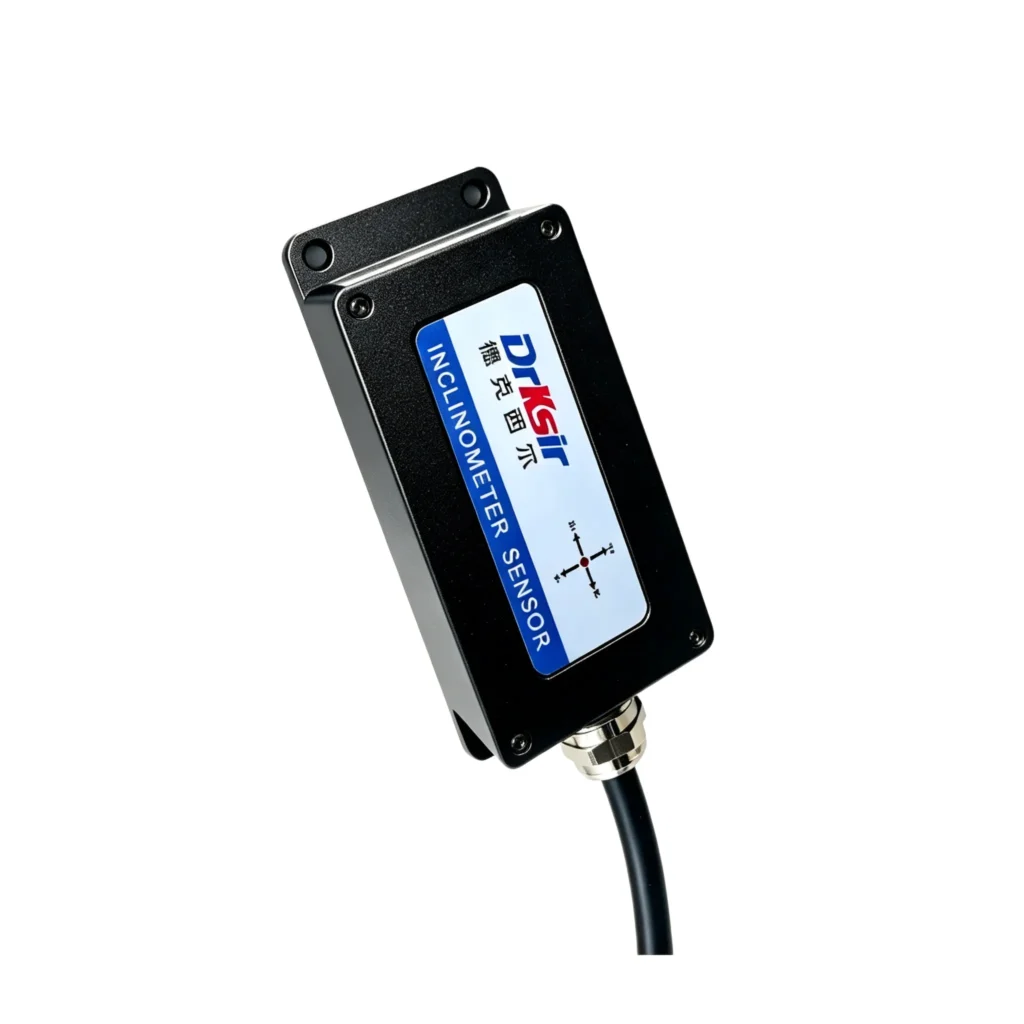
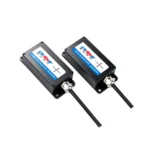
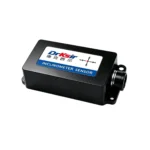
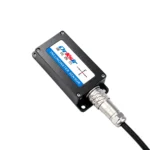
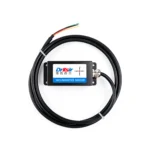
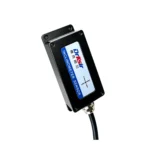
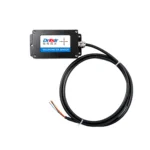
Model: DR-INC-200R
Accuracy: ±0.01° (at room temperature)
Resolution: 0.001° (at room temperature)
Measuring Range: ±30°
Number of Axes: Dual-axis (X+Y)
Output Interface: RS485, Modbus RTU Protocol
Application Scenarios: Ideal for industrial attitude control in construction machinery, bridge structural monitoring, wind turbine tower monitoring, and other industrial scenarios.
The DR-INC-200-R is an industrial-grade inclinometer with 0.01° absolute accuracy and RS485 output, built for construction machinery, where the sensor must survive shock, vibration, and a mounting surface that swings widely. This industrial-grade inclinometer covers ±10° / ±30° / ±60° / ±90° with 0.001° resolution and 100 Hz output, so excavator chassis, crane booms, piling rigs, and shield machines all get live attitude feedback. The Modbus RTU interface keeps wiring to one shielded pair, and the IP67 / IP68 (customizable) housing with a -40°C ~ +85°C rating is built to stay on the machine rather than in a cabinet.
| Parameter | Specification |
| Measuring Axis | Dual-axis X & Y |
| Measuring Range | ±10° / ±30° / ±60° / ±90° (optional, default ±60°) |
| Absolute Accuracy | 0.01° (±10° / ±30°) ; 0.02° (±60° / ±90°) |
| Resolution | 0.001° |
| Sampling Frequency | 100 Hz |
| Power Supply | DC 9~36V |
| Operating Current | 30 mA @ DC 12V |
| Communication Interface | RS485 (Modbus RTU) |
| Operating Temperature | -40°C ~ +85°C |
| Protection Grade | IP67 / IP68 (customizable) |
| Average Service Life | ≥55,000 hours |
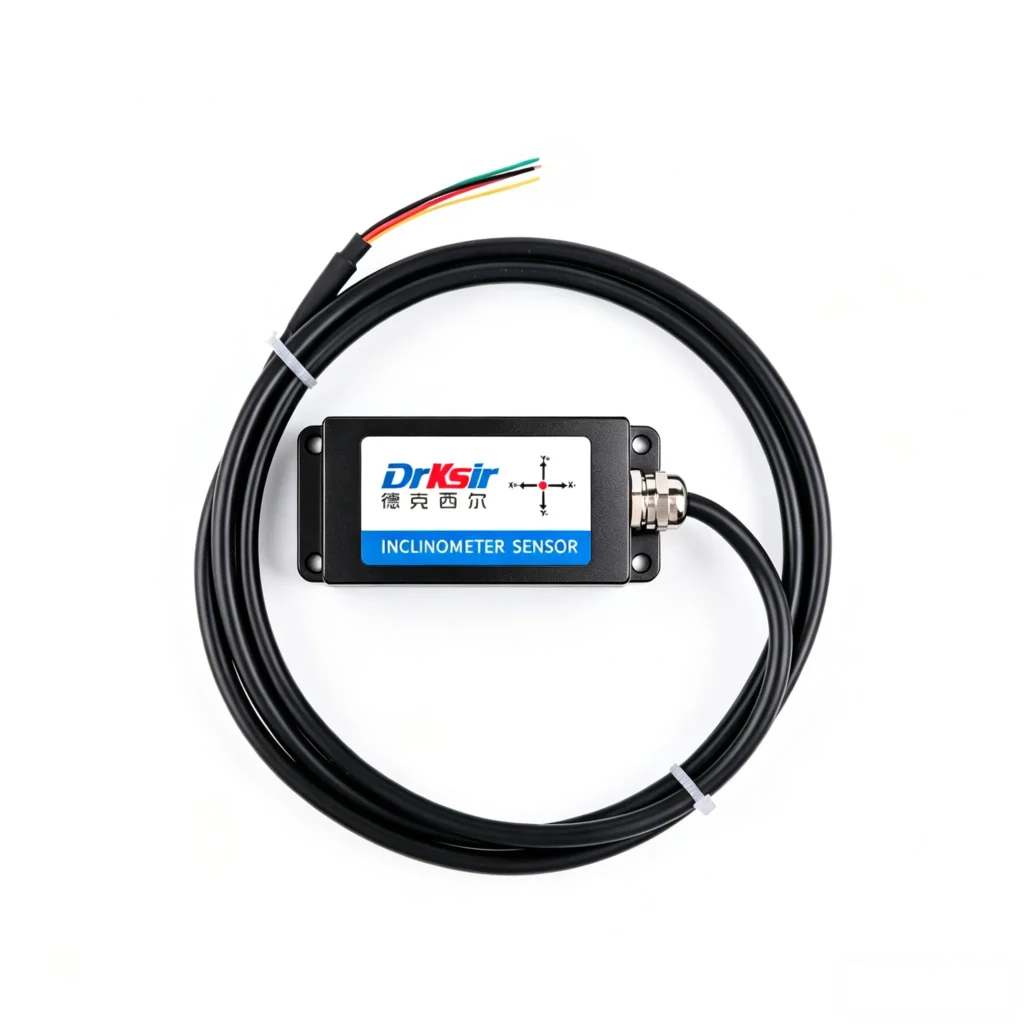
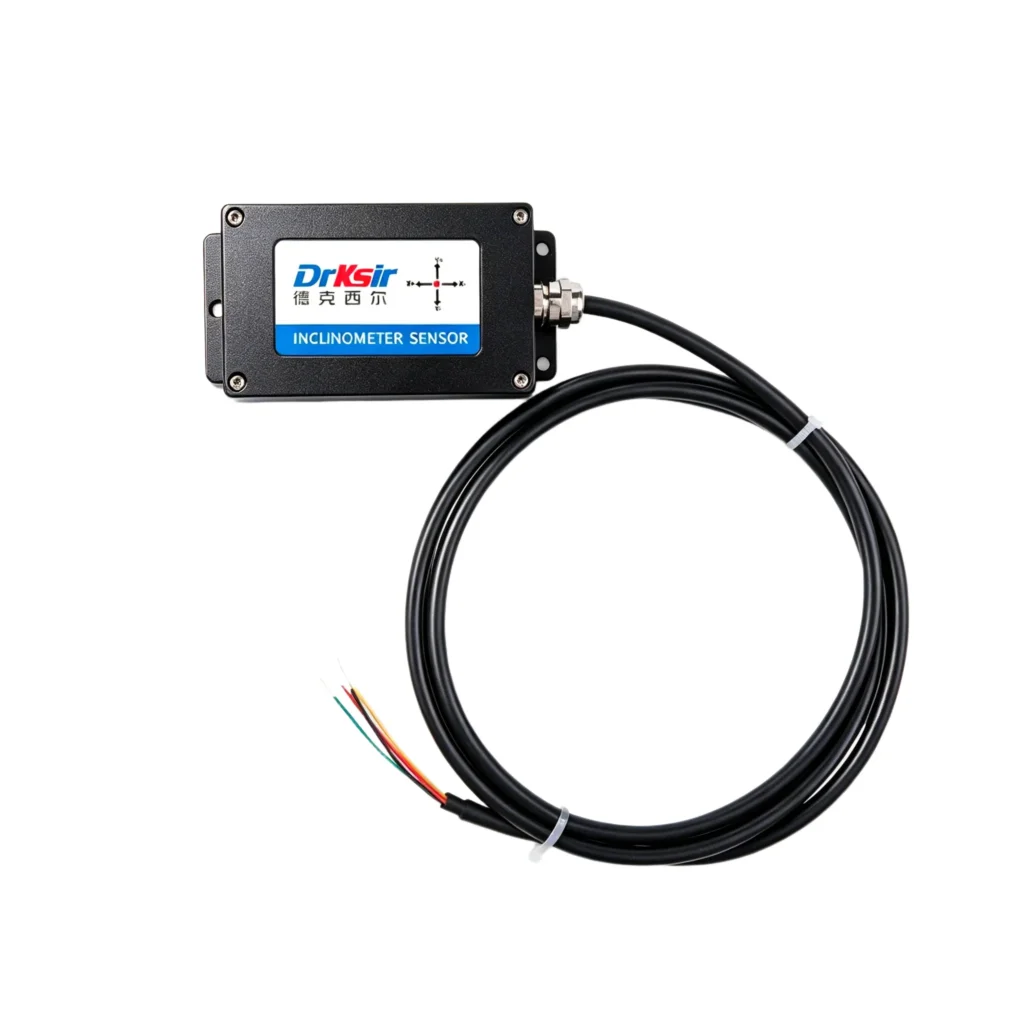
| Cable | Standard 1.5 m 4-core shielded cable |
Mount the sensor rigidly to the machine frame — the measurement is only as stable as the mounting. For highest accuracy, align the sensor’s X-axis to the primary direction of expected tilt.
The sensor uses a 4-core shielded cable for power and data:
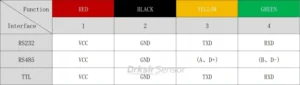
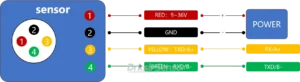
On machinery, route the cable away from motor and hydraulic drive cables, and clamp it so vibration cannot fatigue the conductor at the connector. For RS485 cable runs over 100 m, use shielded twisted pair and terminate the shield at one end only. Maximum recommended cable length is 1,200 m at 9600 baud.
Standard units ship from stock within 5 business days. Custom measuring ranges (±10° / ±30° / ±90° alternate to default ±60°), cable lengths, connector types, and protection-grade options (IP67 vs IP68) are available for OEM/ODM orders starting at 50 units. Typical custom lead time is 15-25 business days. Engineering drawings and integration support are provided free of charge.
Q: Which measuring range should I select?
A: Select the smallest range that covers the machine’s real working arc. On this unit, ±10° and ±30° give 0.01° absolute accuracy, while ±60° and ±90° give 0.02° — accuracy and arc trade off against each other, unlike the 0.005° tier where accuracy is constant across ranges. A crane boom or excavator chassis that swings through tens of degrees is a ±60° or ±90° application; a mast that only needs plumb indication during setup may be a ±30° one.
Q: The product is named 0.01° but the ±60° range is specified at 0.02°. Which applies to me?
A: The figure depends on the range you order. Absolute accuracy is 0.01° at ±10° and ±30°, and 0.02° at ±60° and ±90°. The default SKU -D-60 ships at ±60°, so 0.02° applies unless you specify a narrower range at order time.
Q: What if I need a different accuracy or measuring range?
A: The wired inclinometer family covers 0.1° to 0.001° in one housing family. For tighter accuracy on a tower, the 0.005° High-Precision RS485 Inclinometer holds 0.005° absolute accuracy across ±5° to ±30°. For sub-millidegree structural work, the 0.001° Ultra-High Accuracy RS485 Inclinometer reaches 0.0005° resolution. For simpler leveling tasks at ±90°, the 0.1° General-Purpose RS485 Inclinometer is the lower-cost entry point.
Q: What’s the difference between this sensor and the 4-20mA version?
A: Identical mechanics, accuracy, and dimensions. The RS485 version returns digital values over Modbus RTU; the 0.01° Industrial-Grade 4-20mA Inclinometer outputs a current loop proportional to tilt, preferred where the machine controller only has analog inputs or where the cable run is very long.
Q: Will vibration damage the sensor?
A: The assembly is tested to >20,000 g shock (0.5 ms, 3 impacts per axis) and 10 grms vibration from 10 to 1000 Hz †. In practice the cable routing and mounting stiffness fail first — clamp the cable and bolt the sensor down rather than relying on the housing alone.
📧 Email: sales@drksirsensor.com | 💬 WhatsApp: +86-135-1581-0281
Send us your required quantity, measuring range, output interface, and application scenario. We respond within one business day with pricing, datasheet, and lead time.