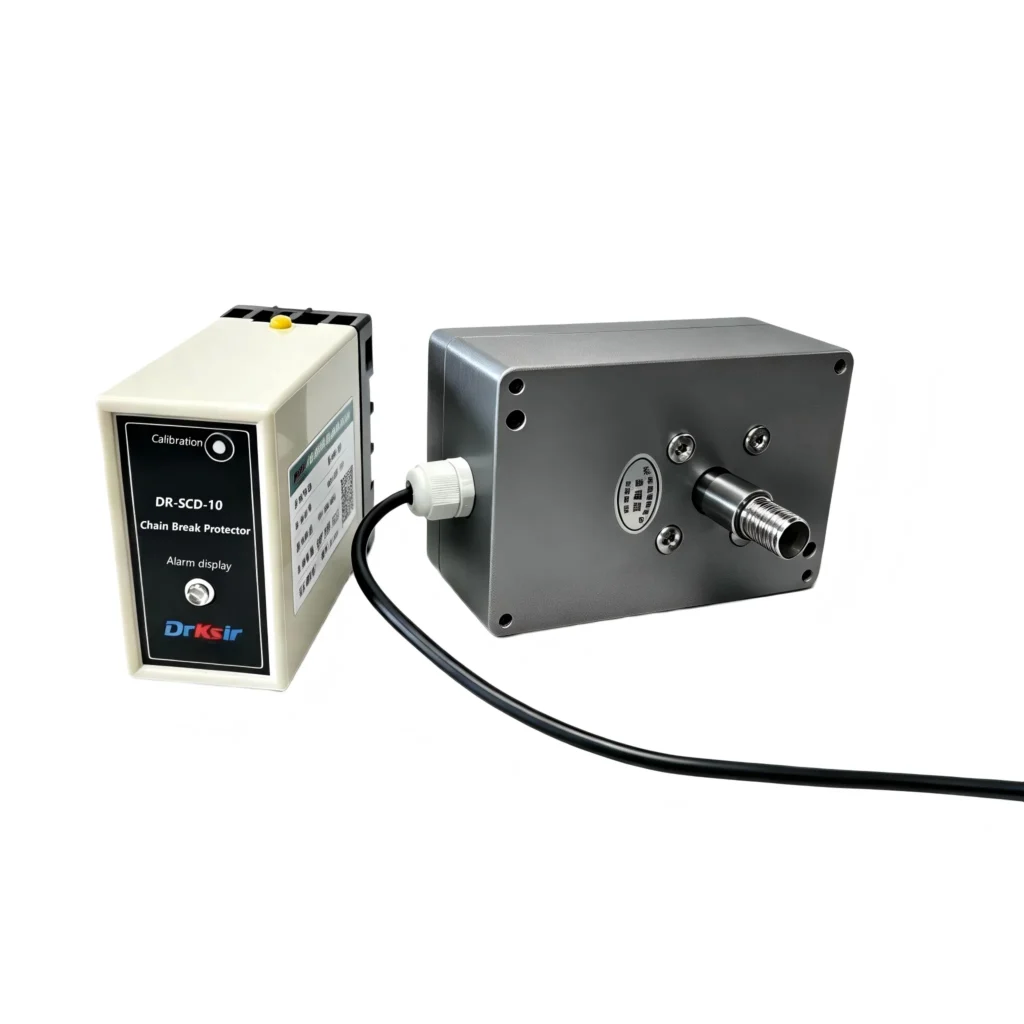
Description
Overview
The drksir DR-ICD-20 is a chain-skew protector that watches the conveyor chain itself rather than the shaft. A non-contact sensor measures the chain as it runs, and the controller compares the two strands (or the chain against its own baseline) to catch skew, tilt and break before the chain jumps the sprocket — the early failure a zero-speed switch alone cannot see.
How It Works
When the conveyor starts, DIP switches 1 and 2 set the fault determination time. As soon as the start (enable) terminal detects a run signal, the processor captures the live chain speed and stores it as the baseline “normal” speed. During operation it keeps monitoring the real-time chain speed. When real-time speed falls between the broken-chain fault value and a higher alarm speed value, the alarm relay fires an early warning that auto-clears once speed recovers; when real-time speed drops below the broken-chain fault value, the fault relay latches and stops the line — a self-locking fault that must be cleared by hand. For dual-chain conveyors, two input channels are compared and a differential alarm time (default ≤1 s) flags a break or skew on either strand. The device remembers the baseline it first learned and re-learns it automatically on the next start after a reset or power loss. Being non-contact, the sensor measures the chain without mechanical coupling and is unaffected by mounting wear.
Key Features
- Non-contact chain sensing — measures the chain without mechanical coupling; immune to mounting wear
- Auto baseline learning — on the first run signal the processor captures and stores the normal chain speed; re-learns automatically after a reset or power loss
- Two-level protection — alarm relay (auto-recovers when speed returns) for early warning; fault relay (self-locking, manual reset) for a confirmed break / skew
- DIP switches 1 & 2 set the fault determination time; dual-channel differential (≤1 s) mode detects break or skew on either strand
- Relay output NO/NC, adjustable trip point
Technical Specifications
| Parameter |
DR-ICD-20 |
| Function |
Chain tilt / skew / break detection |
| Sensing method |
Non-contact chain measurement |
| Monitored object |
Conveyor chain (linear speed / motion) |
| Baseline |
Auto-learned on first run; re-learned after reset / power loss |
| Protection output |
2 relays: alarm (auto-recover) + fault (self-lock, manual reset) |
| Dual-channel mode |
Differential alarm ≤1 s (dual-chain, break & skew detection) |
| Fault determination time |
Set by DIP switch 1 & 2 |
| Trip point |
Adjustable |
| Output |
Relay NO/NC |
| Supply |
220 V AC |
| Protection |
IP65 (IP67 optional) |
Where It Fits
- Chain conveyors prone to skew, climb or derailment
- Long hauls where a single jump-teeth event damages the whole loop
- Lines already protected for chain break, adding misalignment coverage
Additional information